CPC National Collection Plant Profile
|
Delphinium viridescens
Family: |
Ranunculaceae |
Common Names: |
greenish larkspur, Wenatchee larkspur |
Author: |
Leiberg |
Growth Habit: |
Perennial |
CPC
Number: |
1390 |
|
|
|
|
Primary
custodian for this plant in the CPC National Collection of Endangered
Plants is: |
|
Edward Guerrant, Ph.D. contributed to this Plant Profile. |
Delphinium viridescens
|
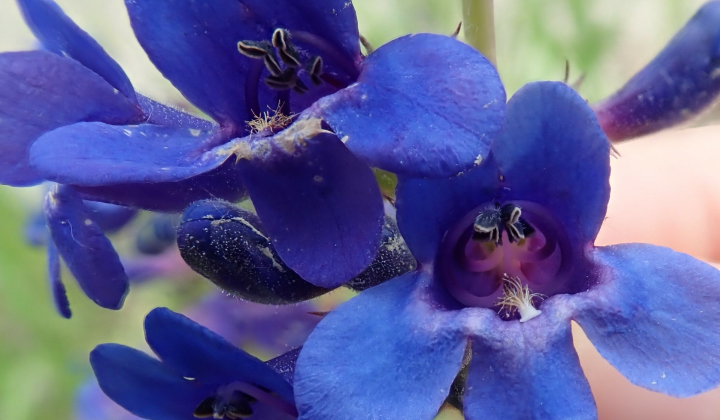
This unusual looking delphinium is tall (3-6 ft or 1-2 m), and has a narrow stalk of 30 to 50 closely spaced greenish-brown flowers. Most delphiniums are blue, purple, or red and attractive to animals (i.e. Hummingbirds) and bumblebees. Delphinium viridescens attracts only bumblebees.
While this rare species can withstand fire, it cannot sustain the constant impact of human activities: residential development, road construction, logging and cattle grazing. Large populations must be maintained in order to preserve the genetic variability within this species.
Distribution
& Occurrence |
|
State Range
Habitat
| |
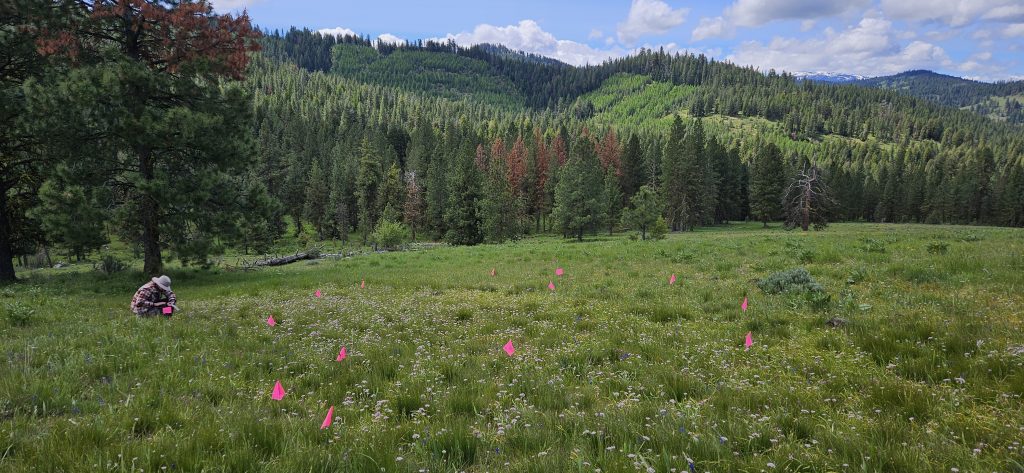
• Moist meadows, moist micro-sites in open coniferous forest, springs, seeps, and riparian areas. All habitats are characterized by surface water or saturated upper soil into early summer, with poorly drained and silty to clayey-loam soil. (WNHP 1999).
• Elevation 1800 to 4200 ft (550-1280 m). |
Distribution
| |
A limited region within the Wenatchee mountains of central Washington. The area is only 20 miles (30 km) long by 6 miles (10 km) wide (at the widest). |
Number Left
| |
Approximately 21 extant populations (Harrod et al. 2000). Population sizes range from 1 to 200 (WNHP 2000). |
State/Area
Protection
| |
State/Area |
Rank |
Status |
Date |
|
| |
|
|
|
|
|
| |
|
|
|
|
|
Conservation,
Ecology & Research |
|
Ecological
Relationships
| |
Little is known about the species' reproductive biology, pollen and seed dispersal, demography or life history (Richter et al. 1994). The flowers are protandrous, meaning that the anthers on an individual flower mature before the stigmas do.
Delphinium viridescens appears to resist fire by re-sprouting from underground rhizomes, an important adaptation in the dry rain-shadow climate of the eastern cascades. Population monitoring reveals that this species performs better after a burn. Monitoring indicated that fire caused no mortality, and population density did not differ between burned and unburned plots. Plants in burned plots were, however, larger and more robust, likely resulting from decreased competition for light. Plants in the burned plots also had more flowers and fruit than those plants in the unburned plots. This final result is consistent with work by Kuhlmann and Everett (unpublished report cited in Harrod et al. 2000) who found that stem length and number of reproductive structures increased as shading increased from 0 to 30% shading but declined with greater shading (Harrod et al. 2000). |
Threats
| |
As cited by the Washington Natural Heritage Program (WNHP 1999), threats include;
• Habitat loss due to residential development.
• Hydrologic changes from development and road construction.
• Timber harvest.
• Livestock grazing. |
Current Research Summary
| |
• Genetic variation was examined within and among populations of this taxon using isozyme electrophoresis. High genetic variability and high levels of heterozygosity were found within and among (between) populations (Richter et al. 1994).
• Examination of Delphinium viridescens response to burn treatment indicates that this species survives in a fire frequent environment by resprouting from well-developed rhizomes (Harrod et al. 2000). |
Current Management Summary
| |
• Endangered status in WA (WNHP 2000).
• Seeds from 7 sites stored at The Berry Botanic Garden. |
Research Management Needs
| |
• Determine extent of rhizome systems using mapping and genetic analysis to determine clones (Richter et al. 1994)
• Analysis of genetic variation within and among populations using molecular markers such as RAPDs, ISSR, or microsatellites (Richter et al. 1994).
• In order to maintain this genetic diversity, at least four large populations must be preserved (projected to maintain 99% of the alleles) (Richter et al. 1994).
• Study reproductive biology, pollen and seed dispersal, demography and life history (Richter et al. 1994).
• Inventory appropriate habitats within range (WNHP 1999).
• Explore the mechanism for increased reproductive output in response to fire in this strongly rhizomatous species. Determine seed germination requirements and conditions that are favorable for seedling establishment (Harrod et al. 2000).
• Prescribed burning (Harrod et al. 2000). |
Ex Situ Needs
| |
• Collect and store seeds from across the species' range.
• Determine germination requirements.
• Determine propagation and reintroduction protocols. |
|
Books (Single Authors)
|
|
Abrams, L.; Ferris, R.S. 1944. Illustrated Flora of the Pacific States: Washington, Oregon, and California. Stanford, CA: Stanford University Press.
|
|
Books (Sections)
|
|
Harrod, R.J.; Knetch, D.; Wilderman, D.; Malmquist, L.A. 2000. The effects of fire on selected rare plants of the Wenatchee Mountains. In: Reichard, S.H.; Dunwiddie, P.W.; Gamon, J.G.; Kruckeberg, A.R.; Salstrom, D.L., editors. Conservation of Washington's Rare Plant and Ecosystem. p 52-59.
|
|
Electronic Sources
|
|
(2002). Rare Plants in Washington, and Research. The Rare Plant Care and Conservation Program at the University of Washington's Center for Urban Horticulture. http://depts.washington.edu/rarecare/index.htm. Accessed: 2002.
|
|
WNHP. (2000). Washington Natural Heritage Program Database. Olympia, Washington.
|
|
Journal Articles
|
|
1897. (Original Publication). Proc. Biol. Soc. Wash. 11: 29.
|
|
Richter, T.S.; Soltis, P.S.; Soltis, D.E. 1994. Genetic variation within and among populations of the narrow endemic, Delphinium viridescens (Ranunculaceae). American Journal of Botany. 81, 8: 1070-1060.
|
|
USFWS. 1996. Notice of Reclassification of 96 Candidate Taxa. Federal Register. 61, 40: 7457-7463.
|
|
USFWS. 1997. Proposed Endangered Status for a Plant in the Wenatchee Mountains of Washington. Federal Register. 62, 148: 41328-41333.
|
|
USFWS. 1999. Determination of Endangered Status for Sidalcea oregana var. calva (Wenatchee Mountains Checker-Mallow). Federal Register. 64, 245: 71680-71687.
|
|
USFWS. 2001. Proposed Designation of Critical Habitat for Sidalcea oregana var. calva (Wenatchee Mountains checker-mallow). Federal Register. 66, 12: 4783-4794.
|
|
Reports
|
|
Kennison, J.A.; Taylor, R.J. 1979. Status Report for Delphinium viridescens. Bellingham, WA: Biology Department, Western Washington University. p.8.
|
|
Loomis, K.; Schuller, R.; Sheehan, M.; Sprague, N. 1985. Report on the Status of Delphinium viridescens Lieberg. Olympia, WA: Washington Natural Heritage Program, Department of Natural Resources. p.25 + appendices.
|
|
Robson, K.A. 1992. A comparative study of the rare Wenatchee larkspur (Delphinium viridescens) and its sympatric relative, Western monkshood (Aconitum columbianum). Portland, Oregon: USDA-USFS, Pacific Northwest Research Station.
|
|
WNHP. 1999. Field Guide to Selected Rare Vascular Plants of Washington. Produced as part of a cooperative project between the Washington Department of Natural Resources, Washington Natural Heritage Program, and the U.S.D.I. Bureau of Land Management, Spokane District.
|
|
Theses
|
|
Loomis, K.M. 1985. An ecological survey of the Wenatchee larkspur Delphinium viridescens. [M.S. Thesis]: Central Washington University. Ellensburg, Washington.
|
|
Varney, D.M. Reproductive biology of four species of Delphinium endemic to the Wenatchee Mountains. [M.S. Thesis]: University of Washington. Seattle, Washington.
|
|
|
|
This
profile was updated on 3/4/2010 |
|